SEO Isn’t Dead. It’s Becoming the Engine Behind AI Search.
If you’ve spent any time on LinkedIn lately, you’ve probably seen the dramatic headlines.
“SEO is dead.”
“Google is over.”
“AI killed organic traffic.”
Search is changing. No question there. But dead? That’s a little dramatic, don’t you think? (We certainly do.) People are using AI tools, voice search, social platforms and Google’s AI-powered results to find answers faster than ever. The old search journey, where someone typed a question, clicked a blue link and browsed a website, is no longer the only path.
That doesn’t mean search engine optimization (SEO) is done for. Not by a long shot! It just means SEO is developing into something bigger.
The work that has always helped your business get found online, including helpful content, strong website structure, reviews, local listings, technical SEO, backlinks and brand authority, is now helping answer engines understand, trust and cite your business.
In other words, your SEO work did not expire. It evolved. Let’s break down what’s changing, what still matters and why the foundation you’ve already built may be more important than ever.
Key Takeaways
- SEO is not dead. It’s expanding into AEO (answer engine optimization), GEO (generative engine optimization) and “search everywhere” visibility.
- AI-powered search is changing how people find information, but AI still depends on quality content, crawlable websites and trusted sources.
- Google says its generative AI search features are still rooted in core Search ranking and quality systems, meaning SEO fundamentals still matter.
- AI Overviews are growing, but they do not eliminate the need for organic visibility. They make clarity, authority and structure even more important.
- The SEO work businesses have already invested in, from website optimization to content strategy, supports the next phase of search.
- The smartest move is not to abandon SEO. It is to strengthen it, structure it for answers and expand visibility across the places your audience searches.
Is SEO dead?
No… but lazy SEO is. The days of writing a basic blog, adding a few keywords and waiting for traffic to roll in are fading fast. Search is more competitive, more fragmented and more answer-driven than ever before.
People are still searching. Google is still massive. Websites still matter. Content still matters. Trust still matters. So what’s changed? The way answers are delivered.
Google’s AI Overviews now summarize info at the top of the search results page. ChatGPT, Claude, Gemini and Perplexity can answer questions conversationally, sorting and serving information from all across the internet. Social platforms like Instagram, YouTube, Reddit and LinkedIn have become search engines, too.
That means your audience is not always landing on your website first. In today’s search-driven world, customers and clients can meet your brand through an AI answer, a review, a YouTube video, a social post, a directory listing (think Google Business Profile or Yellow Pages, if you’re old school) or a third-party mention before they ever click through.
That sounds scary at first, but it also creates more opportunities to be found.
The goal is no longer just ranking No. 1 for a keyword. The goal is to become a trusted answer wherever your audience is searching.
What’s actually changing in search?
The biggest shift is that search is becoming more conversational. People aren’t just typing short phrases like “family lawyer Charleston” or “best allergy clinic near me.” They are asking full questions like: “What should I look for before choosing a family law attorney in South Carolina?” or “How do I know if my child needs to see an allergy specialist?”
These aren’t just keywords. They are real concerns, phrased the way real people think and talk. That matters because AI-powered search is built to answer questions, not just match keywords.
According to Semrush, AI Overviews were triggered for 6.49% of analyzed queries in January 2025, grew to 24.61% in July and settled at 15.69% in November. That fast growth reveals an important truth: AI Overviews are not appearing everywhere, all the time.
So, yes, AI search is growing, AND traditional search is still relevant.
At the same time, Pew Research Center found that users clicked traditional search results less often when an AI summary appeared. Users clicked a traditional result in 8% of visits with an AI summary, compared with the 15% without one.
And that data is important. It teaches us that clicks still matter, and content needs to be clear enough to be summarized, trustworthy enough to be cited and helpful enough to make someone want to learn more.
Meet AEO and GEO, the hottest new duo in digital marketing.
If you’ve researched online marketing lately (or just logged onto LinkedIn), odds are you’ve seen two new acronyms join the ranks of SEO — AEO and GEO.
Confused? It’s simpler than you think. Here’s the breakdown for you normal people who aren’t totally obsessed with digital marketing trends.
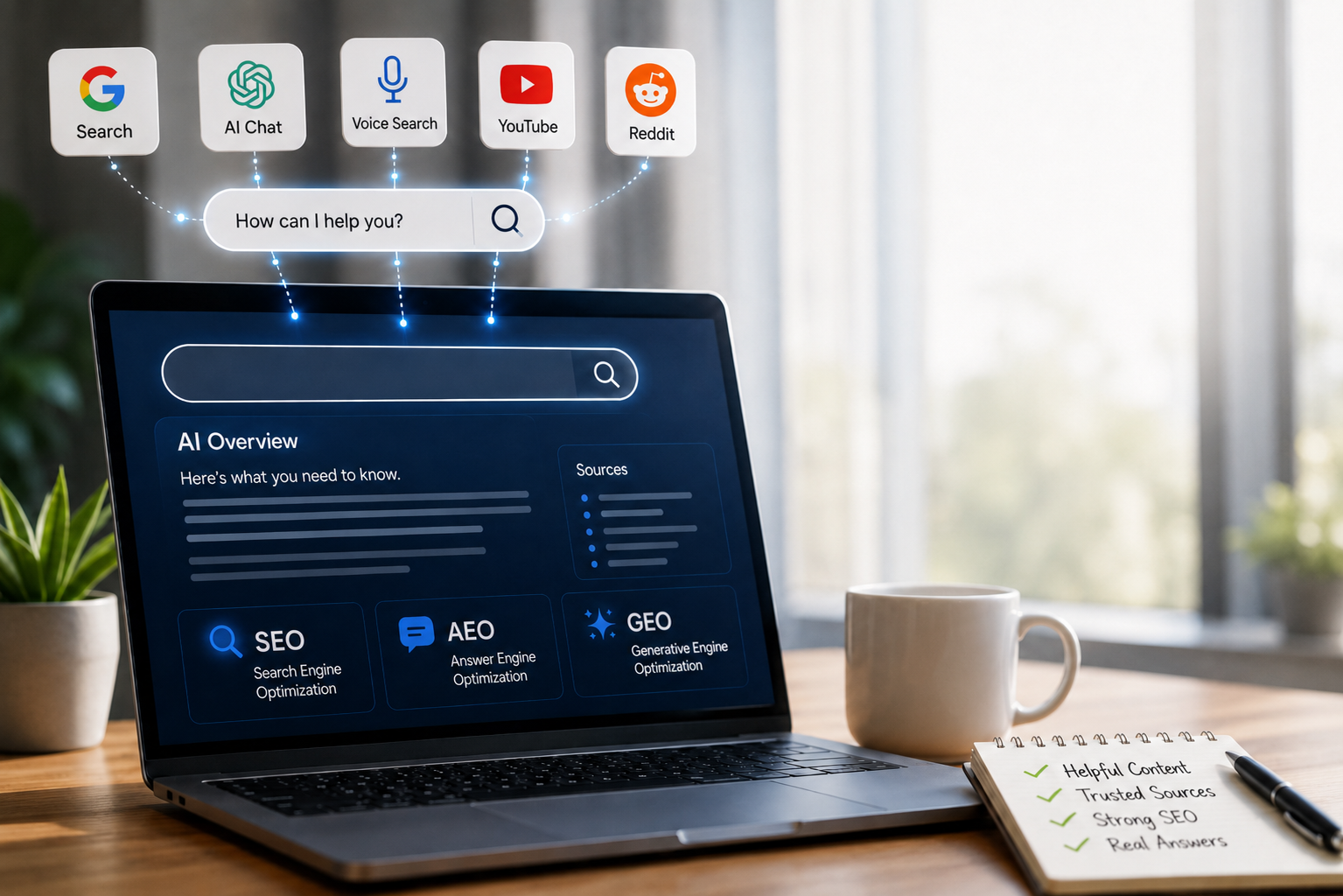
- SEO (search engine optimization) helps your content get found.
- AEO (answer engine optimization) helps your content become the answer.
- GEO (generative engine optimization) helps your content show up in AI-generated responses.
Google has said that, from its perspective, optimizing for generative AI search is still optimizing for the search experience. In other words, AEO and GEO aren’t replacing SEO but are extensions of it. That’s great news for businesses that have already invested in a strong digital marketing strategy! Rather than rebuild, you can build upon what’s already working.
Why Your SEO Investment Still Matters
Here is the part we want every business owner, nonprofit leader and marketing director to hear:
The SEO work you have already done is not wasted. In fact, it may be the very thing helping you show up in this new search environment.
AI tools need sources. They need websites to crawl, content to understand, reviews to analyze and signals of trust to evaluate. They do not pull credibility out of thin air. A strong SEO foundation gives those systems something to work with.
That includes:
- A website that loads quickly and works well on mobile
- Clear service pages that explain what you do
- Blog content that answers real questions
- Strong internal linking that connects related topics
- Schema markup that gives search engines more context
- Google Business Profile optimization
- Reviews and reputation signals
- Consistent directory listings
- High-quality backlinks and brand mentions
- Content that shows real expertise and experience
This is where the “SEO is dead” conversation gets it wrong.
AI is not replacing the need for a strong online presence. It is raising the standard for one. If your website is thin, outdated, hard to crawl or vague about what you do, AI search will not magically fix that. But if your website is clear, helpful, trusted and well structured, you are already in a better position.
Here’s what the new SEO strategy looks like.
Modern SEO is not just about ranking for keywords. It is about building a digital ecosystem that search engines, AI tools and people can understand.
Here’s what that looks like now.
- Helpful content comes first.
Google’s guidance is clear: create content that is unique, useful and people-first.
That means content should do more than repeat what every competitor is already saying. It should answer the questions your audience actually asks, explain topics clearly and reflect your real expertise.
For businesses, that might mean creating blogs, FAQs, service pages, guides, videos or case studies that help people make decisions.
For example, a law firm should not only have a page that says “We handle divorce cases.” It should explain what someone can expect during the process, what questions to ask and what steps to take first.
A medical practice should not only list conditions treated. It should explain symptoms, appointment expectations and when someone should seek care.
That kind of content helps humans. It also helps AI understand why your business is relevant.
- Structure matters more than ever.
AI tools like organized information. So do people. Clear headings, short sections, FAQs, bullets, summaries and direct answers all make content easier to scan and easier to understand.
That does not mean writing robotic content for algorithms. It means making your expertise easy to find.
A good rule of thumb: answer the question early, then add helpful context.
If the section is titled “How often should I update my website content?” the first sentence should answer that question. Then you can explain the strategy behind it.
- Technical SEO is still the entry ticket.
Your content cannot perform if search engines can’t find it, crawl it or understand it.
Technical SEO may not be glamorous, but it’s still essential. Site speed, mobile usability, crawlability, indexing, page experience, broken links, duplicate content and schema all play a role. Think of technical SEO as the wiring behind the walls. Your audience may not see it, but everything works better when it’s done right.
Google has also said that the way Search finds and processes pages remains central to how its AI systems access content.
So yes, the technical foundation still matters… a lot.
- Authority now lives across the web.
Your website is important, but it’s not the only place your brand is evaluated.
AI search looks at the broader web, including reviews, local listings, third-party directories, YouTube videos, social content, Reddit discussions, news mentions and other credible sources. That’s why brand consistency matters.
If your business name, services, hours, locations or descriptions are inconsistent across the internet, that creates confusion, and confusion is exactly what we in the biz would call a trust signal.
- Brand trust is becoming a ranking signal you can feel.
E-E-A-T (experience, expertise, authoritativeness and trustworthiness) has been part of the SEO conversation for years. In the AI era, it matters even more.
Search engines and answer engines want to surface information that feels credible. That means brands need to show who they are, what they know and why people should trust them.
That can include:
- Named authors
- Clear credentials
- Updated content
- Client stories or case studies
- Strong reviews
- Accurate citations
- Real examples
- Consistent messaging
- Transparent service information
AI may be the shiny new tool in the room, but trust is still the whole game.
AEO Does Not Replace SEO. It Rewards Strong SEO.
One of the biggest myths right now is that businesses need a completely separate “AI search strategy” that has nothing to do with SEO. In reality, it’s all connected. AEO builds on SEO, GEO builds on SEO, and AI visibility builds on SEO.
A strong SEO strategy already focuses on the things answer engines care about: clarity, usefulness, authority, structure and trust. The difference is that content now needs to be built for multiple search experiences.
A person might find you through:
- Google search results
- Google AI Overviews
- ChatGPT responses
- Perplexity citations
- YouTube videos
- LinkedIn posts
- Review sites
- A local directory
- Reddit threads
- Google Business Profile results
That’s not a reason to panic, though. It’s a reason to connect the dots. Your SEO strategy should now support search everywhere, not just search engines.
How will AEO, GEO and SEO affect businesses working with marketing agencies?
If you’re working with a marketing agency like TRIO, here is the good news. This is not a reset.
The work we do across websites, SEO, content, analytics, paid media, social media, reputation management and brand strategy all plays a role in this new search environment.
- A fast, organized website helps search engines understand you.
- Helpful content helps answer engines trust you.
- Reviews help validate you.
- Local listings help place you.
- Social content helps humanize you.
- Analytics help us see what is working.
- Brand strategy helps make your message consistent everywhere.
AI search may be changing how people discover information, but the goal is the same: help the right people find the right answer at the right time. That’s the value of having an integrated marketing strategy. The pieces support each other.
If you do the work right, you become the answer your target audience is looking for.
Become the answer AI serves.
The businesses that win in an AI-driven world are those that build strong digital foundations. If you want to evolve your SEO game or are wondering how to adapt your strategy for AI-powered search, TRIO can help you make sense of what is changing, what is worth your attention and what to do next. Let’s make sure your business is not just searchable. Let’s make it answer-worthy. Contact our team today!

Digital Marketing Specialist