Local SEO for Small Businesses: How to Show Up in “Near Me” Searches

“What is local SEO?” It’s a question many business owners ask. It’s one you likely just Google. Otherwise, why would you be here, right?
Local SEO, or local search engine optimization, is the process of improving your online presence so your business appears in search results when people look for products or services in a specific geographic area.
Think about the last time you searched for something nearby. Maybe it was a restaurant in Mount Pleasant, an allergist in Charleston or an event venue in the Lowcountry. Chances are, you weren’t casually browsing. You had a need or desire and were looking for a business that could meet it.
And if you found your answer? Voila! That’s the power of local search.
Search is about intent.
Broad searches such as “best marketing agency” or “preschool” can still deliver nearby results based on your location; however, local searches signal a stronger intent to take action. Someone searching for “marketing agency near me” is likely looking for a provider in their area, not a list of agencies across the country.
Local SEO helps your business become part of that conversation.
And while Google is often the first place people turn, local visibility isn’t limited to one search engine. Your website, online directories, reviews and other digital touchpoints all contribute to how easily customers can find and recognize your business.
Even AI plays a role these days. You can learn more about AEO (answer engine optimization) and SEO in our other blog: “SEO Isn’t Dead. It’s Becoming the Engine Behind AI Search.”
Why does local SEO matter for small businesses?
Being visible in the right places can often make or break small businesses. After all, you don’t necessarily need to compete with national brands for broad search terms when your most valuable customers are right down the road.
A well-developed local SEO strategy helps you:
- Connect with local customers who are actively searching for the products or services you offer.
- Compete in your geographic market by improving visibility in local search results, even when larger national brands dominate broader searches.
- Help prospective customers feel confident choosing your business by making your location, hours, reviews and services easy to find.
- Bring more qualified visitors to your website who are ready to call, request a quote, schedule an appointment or stop by.
- Strengthen your presence in the community by making it easier for nearby customers to discover your business and what you offer.
For a small business in Charleston, this could mean showing up when someone searches for a family law attorney in South Carolina, a coffee shop in Summerville or an award-winning marketing agency serving the Lowcountry for 25 years. (Oh, hey! Skip the search and just contact us here.)
Anyway… back to the blog. The goal isn’t to show up in every search. It’s to show up in the searches that matter.
Where does your business appear in local search results?
When someone performs a local search on Google, they may encounter two primary types of results: the local map pack and traditional organic search listings.
The Local Map Pack 👇
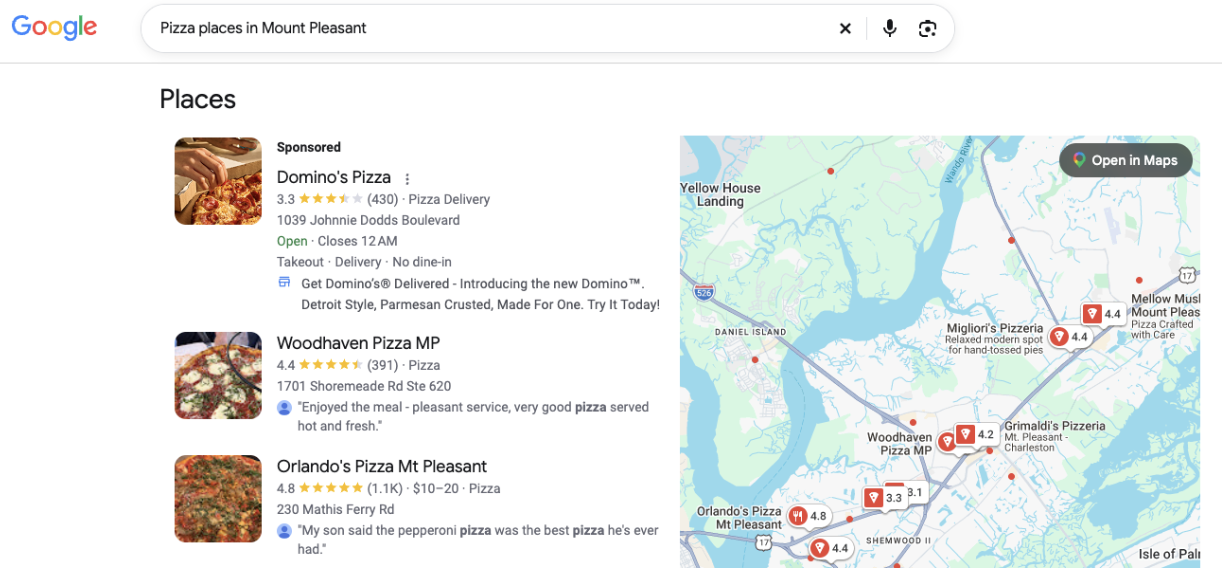
The local map pack is the section of Google search results that displays a map alongside a selection of nearby businesses. These listings typically include business names, review ratings, locations, hours and other helpful details.
For searches with local intent, the map pack often appears near the top of the results page, giving businesses an opportunity to capture attention before someone even visits a website.
Oh, and did we mention? Sponsored results can also appear in map pack results. (We see you, Domino’s.) As you battle against big brands and nearby mom-and-pops, your Google Business Profile plays an important role in maintaining visibility.
Traditional Organic Results 👇
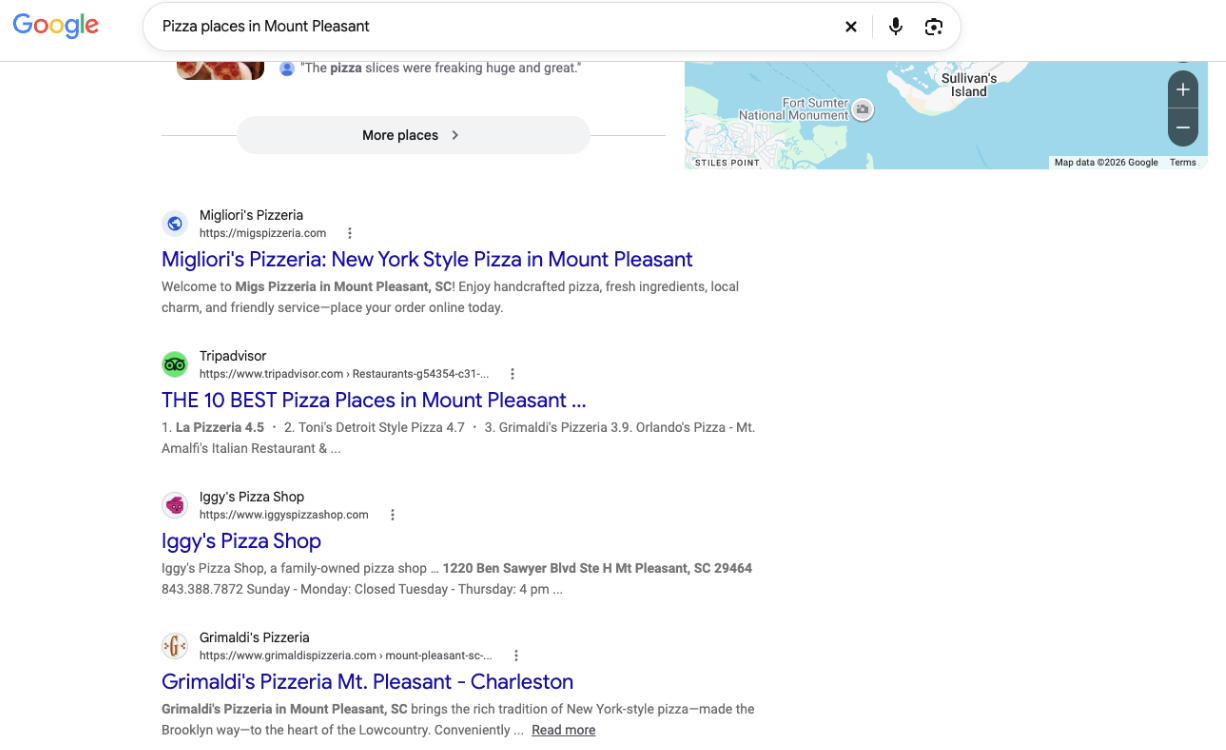
Below or around the map pack, Google displays traditional organic search results. These are website pages that Google’s algorithm determines are relevant to the search.
For example, a Mount Pleasant preschool might appear in the map pack because of its Google Business Profile, while its website’s enrollment page or a blog about early childhood education could appear in organic results.
Both are valuable, and a strong local SEO strategy works to improve your visibility in the map pack and traditional search results, creating more opportunities for prospective customers to find you.
Try these 5 ways to improve your local SEO.
So, how do you actually improve your local search visibility? While Google’s local search algorithm considers several factors, Google identifies three primary ranking factors: relevance, distance and prominence.
Here’s the breakdown:
- Relevance: How well your business matches what someone is searching for.
- Distance: How far your business is from the person searching.
- Prominence: How well-known or established your business is, based on information such as links from other websites and customer reviews.
You can’t control every factor, particularly how far away someone is searching from. But there are several things you can do to strengthen your local SEO foundation.
1. Claim and optimize your Google Business Profile.
If there’s one place eligible small businesses should start, it’s Google Business Profile (GBP).
This free tool allows you to manage how your business appears across Google Search and Google Maps and gives prospective customers quick access to key information, including your business name, address, phone number, hours, website and services.
When complete and accurate, your GBP profile helps Google understand what your business offers and where you operate.
Not sure how to set up your GBP? At a minimum, make sure your profile includes:
- Your accurate business name and primary business category
- Current contact information and business hours
- A complete business description
- Relevant products and services
- High-quality photos
- An accurate physical location or service area, as applicable
And remember, don’t treat your profile as a one-time setup, either. Your business will evolve, so your info will too.
2. Keep your business information consistent across the web.
Your business info should tell the same story wherever customers find you online. In local SEO, this is often referred to as NAP consistency: Name, Address and Phone Number.
If your website lists one phone number, your Google Business Profile lists another and an online directory still lists your old address, those inconsistencies can confuse customers and make it harder to build trust in your operation.
Start by checking your business listings across:
- Your website
- Google Business Profile
- Social media accounts
- Online business directories
- Industry-specific directories and associations
These listings are also known as citations. They help establish your business’s online presence and reinforce important location information.
A little housekeeping can go a long way in the world of SEO and AEO. So, if you’ve moved offices, changed phone numbers or updated your business name, make sure those changes are reflected consistently across your digital presence.
3. Build a strong review strategy.
Online reviews do more than help prospective customers decide whether you’re the right fit. Reviews are also an important part of your local SEO strategy.
Google considers review information, including the number of reviews and positive ratings, when determining local prominence. Reviews also give potential customers a firsthand look at the experience your business provides.
A few best practices:
- Ask customers to share honest feedback about their experiences.
- Make it easy by providing a direct link to your Google review page.
- Thank customers for positive feedback and address negative reviews professionally.
- Never purchase reviews, offer incentives in exchange for positive ratings or pressure customers to leave feedback.
And while five-star reviews are the gold standard, don’t ONLY focus on them. A steady stream of genuine feedback and thoughtful responses helps demonstrate that your business is active, engaged and invested in its customers.
With enough positive experiences and trust built, some customers can even become unofficial members of your marketing team. Learn more about how to leverage UGC (user-generated content) in this article.
4. Create content that speaks to your community.
Your website should make it easy for both search engines and prospective customers to understand where you operate and what you offer. One way to do this is through localized content.
Rather than relying exclusively on broad service descriptions, incorporate relevant geographic details throughout your website. This could include:
- Location-specific service pages
- Blogs addressing local questions or challenges
- Community news, events and partnerships
- Customer testimonials that reference your service area
- Project highlights featuring local clients or organizations
For example, a landscaping company serving the Charleston area might publish a blog about preparing Lowcountry yards for hurricane season. A childcare center in Ohio could create a resource for local parents comparing early education options.
The important thing is to make the content genuinely useful.
Adding “Charleston” or “Mount Pleasant” to every other sentence isn’t a local SEO strategy. Creating content that demonstrates your knowledge of the community is.
“But what if I serve multiple locations?”
If your business operates across several cities or service areas, consider creating dedicated location pages. These pages should offer unique, relevant information about the services you provide in each area rather than simply swapping out city names on identical pages.
In a nutshell, a well-developed location page can help customers understand where you work, what services are available and how to get started.
5. Strengthen your website’s technical SEO.
Even the best local content needs a solid website to back it up. Whether Squarespace or WordPress, working with a skilled web developer and web hosting partner is an excellent way to keep your website safe, up to date and secure.
Technical SEO helps search engines crawl, understand and index your website. It also contributes to the experience people have when they visit.
For local businesses, a few important considerations include:
- Mobile responsiveness: Make sure your website works well on smartphones, where many local searches happen.
- Page speed: Optimize your website so pages load quickly and visitors aren’t left waiting.
- Clear contact information: Make your address, phone number and service areas easy to find.
- Internal linking: Connect relevant pages throughout your website to help visitors and search engines navigate your content.
- Local business schema: Use structured data to help search engines understand important business details, such as your location, contact information and hours.
You don’t need to become a technical SEO expert to recognize the importance of these elements. A well-built, well-maintained website provides a stronger foundation for your local SEO strategy.
When will you see results from local SEO?
Local SEO is a long-term investment, not an overnight fix.
Some improvements, such as correcting outdated business information or completing your Google Business Profile, may help customers find accurate information relatively quickly. Other efforts, including building website authority, earning reviews and developing localized content, take time to gain traction.
Your timeline will depend on several factors, including:
- How competitive your industry and service area are
- How established your website and online presence already are
- The quality and consistency of your content
- Your business’s prominence and reputation
- How frequently you maintain and improve your local SEO efforts
A business competing for “healthcare in Charleston” may face a very different challenge than one targeting a more specialized service in a smaller community.
The important thing is to monitor progress over time. Track local search visibility, website traffic, calls, direction requests and inquiries to understand which efforts are making a difference.
Get discovered where it matters most!
Your next customer could be searching for your services right now. The question is whether they’ll find you or your competition. So what do you say? Ready to make your business easier to find? Let’s talk about your SEO and digital marketing strategy. Explore TRIO’s marketing solutions or contact our team to get started.
Frequently Asked Questions About Local SEO
1. What is local SEO?
Local SEO is the process of optimizing your online presence to help your business appear in search results when people look for products or services in a specific geographic area. It includes optimizing your Google Business Profile, maintaining consistent business information, earning customer reviews and creating location-relevant website content.
2. How is local SEO different from regular SEO?
Traditional SEO focuses on improving your website’s visibility for relevant searches, regardless of where the searcher is located. Local SEO adds a geographic component, helping businesses appear when people search for nearby products, services or providers. Both strategies work together to attract relevant website traffic and potential customers.
3. How long does local SEO take to work?
Local SEO results vary depending on your industry’s competition, your location and the strength of your existing online presence. Some improvements may have an impact relatively quickly, while building authority, earning reviews and improving organic rankings can take several months or longer. Consistent optimization and monitoring are essential for long-term results.
4. Do I need a physical address to rank in local search results?
No. Businesses that travel to customers, such as plumbers, contractors and other service-area businesses, can qualify for a Google Business Profile without publicly displaying their address. However, they must have an eligible business location and accurately define the areas they serve. Virtual offices and mailbox addresses generally don’t qualify. Eligible service-area businesses can hide their address on GBP, but they still need a legitimate location that meets Google’s eligibility and verification requirements.
5. How much does local SEO cost?
Local SEO costs depend on your business’s needs, competition, service area and the amount of ongoing optimization required. Some businesses can manage basic tasks in-house, while others benefit from professional support with SEO strategy, content development, website optimization and ongoing reporting. The best investment is one that aligns with your goals and provides a sustainable path to better visibility.

Digital Marketing Specialist